
World Cup Forecasts

Last week I officially retired from my job as a Professor at the University of Michigan, but since I intend to carry on my research, I thought I would start a substack to share opinions that I can no longer impose on unsuspecting undergraduates.
To start off I’m going to post the results of my World Cup forecasts. My approach was to use publicly available measures of ability for each team, generate expected results based on a model, and then simulate the model 10,000 times.
My interest was in comparing two measures of ability. One is the Elo rating for each team, which I generated using international match results for each team. The other used Transfermarkt values, which are essentially crowd sourced estimates of individual player abilities, which you can then add up to get value of each squad.
The table below shows the results for each model, with the probability of reaching each stage.
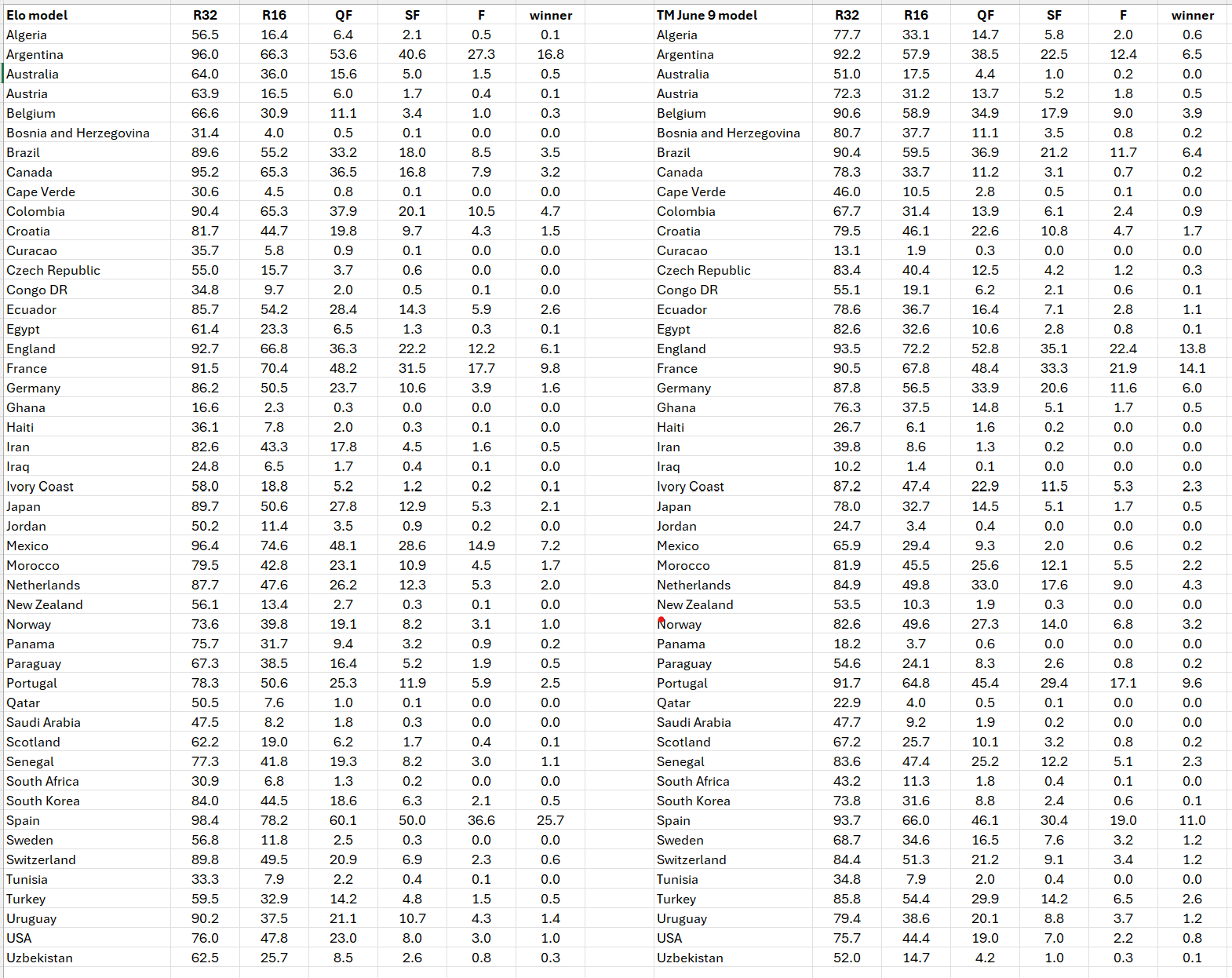
While there is a fairly strong correlation between the two models (around +.65) there are some sharp differences. The Elo model has Spain as runaway favourites, and the Transfermarkt (TM) model has Spain, France and England with similar probabilities.
I think the main reason for the difference is this - the TM model uses player valuations that mainly reflect each player’s performance for their club, not the national team. The Elo rating is based solely on the performances of the national team.
It’s not clear which is better. The Elo rating may be derived from players who have not even played for the national team recently. The TM value says little about the cohesion of the national squad. The TM predictions seem closer to the bookmaker probabilities, but that might just be herding.
Happily for the competition, the prospect of the biggest favourites are so low that they are far more likely to fail - there is much uncertainty to be resolved.